Whether it’s the 33% of the world’s population who wear braces, or the 20 million individuals worldwide who use Invisalign, teeth-straightening methods practiced by orthodontists shape a patient’s life for many years—if not the rest of it.
While some people medically require braces, for others, it’s an optional commitment—though certainly not an easy one. It’s important to understand which treatment best suits one’s specific needs and lifestyle.
“At the first consultation, [orthodontists] are looking at their photos, lifestyle, and what kind of a person they are. If they are someone that’s going to keep track of oral hygiene, it’s a different case,” Director of Operations at Pioneer Orthodontics, Cheri Jarosik said. “We look at all of those things and then decide what treatment is going to be best. It’s a very individualized treatment plan we put together.”
Both braces and Invisalign provide the same result: a straighter, healthier smile. However, the journey to get there is where the difference lies. Depending on the individual, the pros and cons of each option can make or break the final decision.
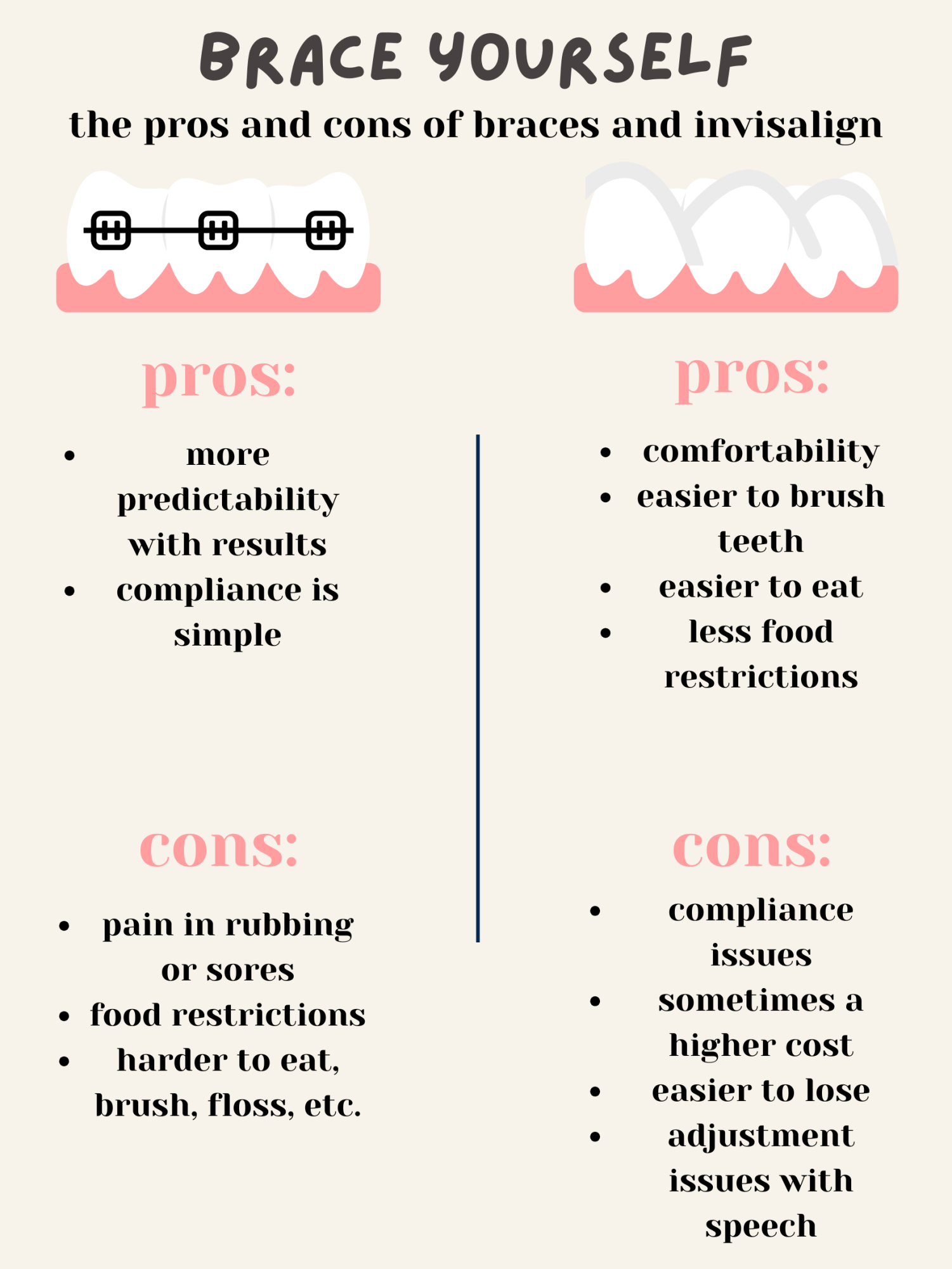
“The pros of clear aligners are that they can be more comfortable for the patient. It’s easier to brush and eat because you’re taking them in and out. The cons are that it’s easier to have compliance issues. Patients aren’t very good about wearing them because they are the ones in charge of the maintenance 22 hours a day, so, at times, they aren’t getting the results they need,” Jarosik added. “The pros of braces are that the orthodontist is a lot more hands-on with all the movements so he can really tweak and perfect the smile. There is more predictability with braces because they can physically keep moving.”
Many young individuals lean toward braces due to its straightforward process and the comfort of knowing it’s a mostly guaranteed result. There’s also a certain trendiness attached to braces in the colored bands and style opportunities. Still, they’re far from low-maintenance.
“I brush my teeth more than two times a day; it’s probably around four or five. Everytime I leave my house, I have to brush my teeth. I had already known about water flossers and electrical toothbrushes since eighth grade,” sophomore Elena Graves said. “Of course there’s also the rubber bands you’re supposed to wear that you forget about and end up lying to your orthodontist the next time you see them.”
Adults, on the other hand, often prefer Invisalign for its subtle appearance, less pain, and flexibility. An increasing number of younger patients, however, are also choosing Invisalign for the same reasons.
“Braces seem more scary with all the pain and wires in my teeth. I’ve heard a lot of worse things about it, like getting cut or just a generally bad experience,” sophomore Charlie Sanchez-Masi said. “Invisalign was a more mild and [concealed] alternative with a simple daily routine. I have them in while I sleep, I brush my teeth and put them back in then keep them on until lunch where I take them off and the same applies to dinner.”
Invisalign is favored for its invisible look, ease while eating or brushing, and generally reduced discomfort. Braces, however, offer a more predictable outcome and are often seen as a more personal, hands-on journey with a typically lower cost. Both methods ultimately achieve the same goal of teeth alignment, yet neither of them outshine the other. In the end, orthodontic treatment is a lifetime commitment; even after the process is complete, wearing retainers becomes an essential part of maintaining a straight smile.