Teachers frequently point out that phone screens are damaging their students’ minds and distracting them during class, hence the student-despised phone policy. As of the 2025 school year, Lincoln Public Schools implemented a strict no-phone policy during class to limit interference with teaching. In theory it was a good idea, but distractions still remain in the classroom in the form of another screen: chromebooks.

Society has been so concerned with the social media and phone epidemic that they have ignored the fact that students are still spending 5-7 hours a day online. After the Covid-19 pandemic, chromebooks became the norm for schools around the world because of the convenience and availability of the devices. Without them, students wouldn’t have had access to Zoom or Google Classroom. At the time, it was a valuable solution for learning, but now there is a heavy reliance on technology in the classroom, even with the phone restrictions.
There are many arguments that Chromebooks increase students’ grades because they have the world at their fingertips, yet that’s not proven accurate. A large number of students don’t use their school issued Chromebooks for the right reasons, either procrastinating on their assignments or completing them with AI.
According to a New York Times article titled Chromebook Remorse: Tech Backlash at Schools Extend Beyond Phones, digital tools can impede on learning due to the dependence on technology. This means that not only are Chromebooks distracting students and teachers, but they’re also slowing down the learning process.
“Even then, some educators said they were spending so much time policing student Chromebook use that it was detracting from teaching,” Natasha Singer, a reporter for New York Times, said.
Digital learning also limits the creative freedom students have to learn in a productive way. Completing documents and reading slides isn’t how the majority of students learn well, even if it’s the easiest technique for teachers. If more classrooms switched to paper notes, students would be able to design the page in a way that made sense to them.
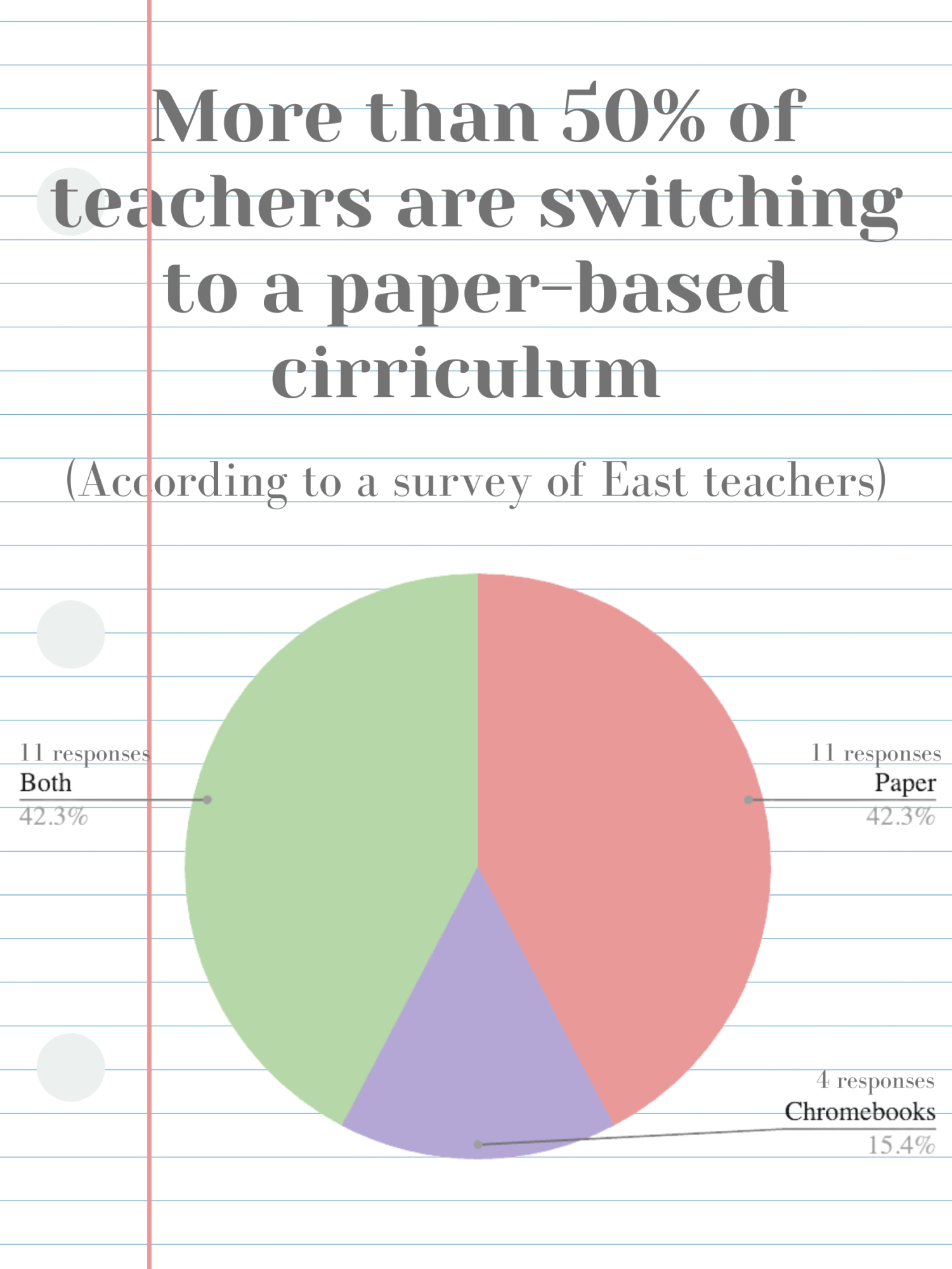
“I think being able to have the visual and creative freedom is important, because some people are going to do basic notes, while some are more illustrated,” Benjamin Leathers-Arnold, an English teacher at East High School, said. “This way it’s more impactful when you’re trying to remember something when you took time to intentionally organize something.”
A few years ago, Mr. Leathers-Arnold completed an experiment where he taught one day with all paper and another all online. He wanted to know how the different platforms would affect the students’ focus. He hypothesized that switching to paper would require more of the student’s attention because it’s hands-on work.
“On digital copy days I got about 38% of students who would turn in a digital copy, completed or at least started,” Leathers-Arnold said. “On paper copy days that number was closer to 87%.”
Not only is paper preferred among students, proven through multiple studies and polls, but it’s also beneficial for learning. It’s time to rewrite how students learn by closing the computer and picking up a pencil.